

The Hidden Epidemic: Why Stress Is Driving the Hypertension Crisis — and What Medicine Is Missing
By Yair Lurie, Founder & CEO, Cardiowell
The numbers that should have stopped us
In the last decade, blood pressure medication prescriptions in the United States rose by 41%. [1]
Hypertension rates rose anyway. Up 11% overall. Up 29% in adults under 40. And now appearing in children as young as 8. [2]
I have spent more than a decade working in hypertension technology, and these two numbers are the ones I keep coming back to. More prescriptions. More disease. Moving in the same direction at the same time.
That is not a treatment failure in the conventional sense. The medications work. The problem is that we are treating the symptom with increasing precision while the cause continues to grow — and medicine has been slow to name that directly.
Primary hypertension — the kind with no identifiable medical explanation — accounts for 95% of all hypertension diagnoses. The formal classification calls it "essential" or "idiopathic." Those are clinical terms for "we don't know why." [3]
The evidence has been accumulating for years, and we do know why. Or at least, we know enough to do something different.
What the body does under pressure
The human stress response was not designed for the conditions most adults in industrialized countries live under today.
When the nervous system perceives a threat — whether that threat is a predator or a mortgage payment — it activates the same cascade. Cortisol rises. Adrenaline floods the system. The heart beats faster. Blood vessels constrict. Blood pressure goes up.
For a brief, physical emergency, this is adaptive. The system returns to baseline once the threat passes.
The problem is that for many people, the threat never passes. Financial pressure, social isolation, chronic workplace stress, caregiving burden, political anxiety — these are not the kind of threats the body knows how to resolve in a single burst of adrenaline. They persist. And when the stress response persists, the cardiovascular system adapts to a new, higher baseline.
The American Psychological Association found that 76% of adults now report physical health impacts from stress — up from 64% five years earlier. [4] Gallup's Global Emotions Report found that 55% of Americans experience significant stress on any given day, among the highest rates in the world, up 8% since 2019. [5]
That burden is accumulating in the body. Blood pressure is one of the ways it shows up.
Emotion suppression as a cardiovascular risk factor
One of the most consistent findings in psychosomatic medicine is also one of the least discussed in primary care: the way people handle their emotions has measurable, predictable effects on blood pressure.
This is not soft science. It is documented, replicated, and quantified.
Research published in the Journal of Behavioral Medicine found that people who habitually suppress negative emotions — who swallow their words, push down anger, perform calm they don't feel — have blood pressure readings 10–15 points higher than people who process their emotions more openly. [6] That gap is equivalent to carrying 50 extra pounds, or ageing an additional decade in cardiovascular terms.
Think about what that means in a clinic. A patient sitting across from you who holds everything together, who has been told — implicitly or explicitly — that strength means silence, is carrying a self-generated cardiovascular burden that no medication can resolve. The medication brings the reading down. It cannot stop the suppression that is driving it up.
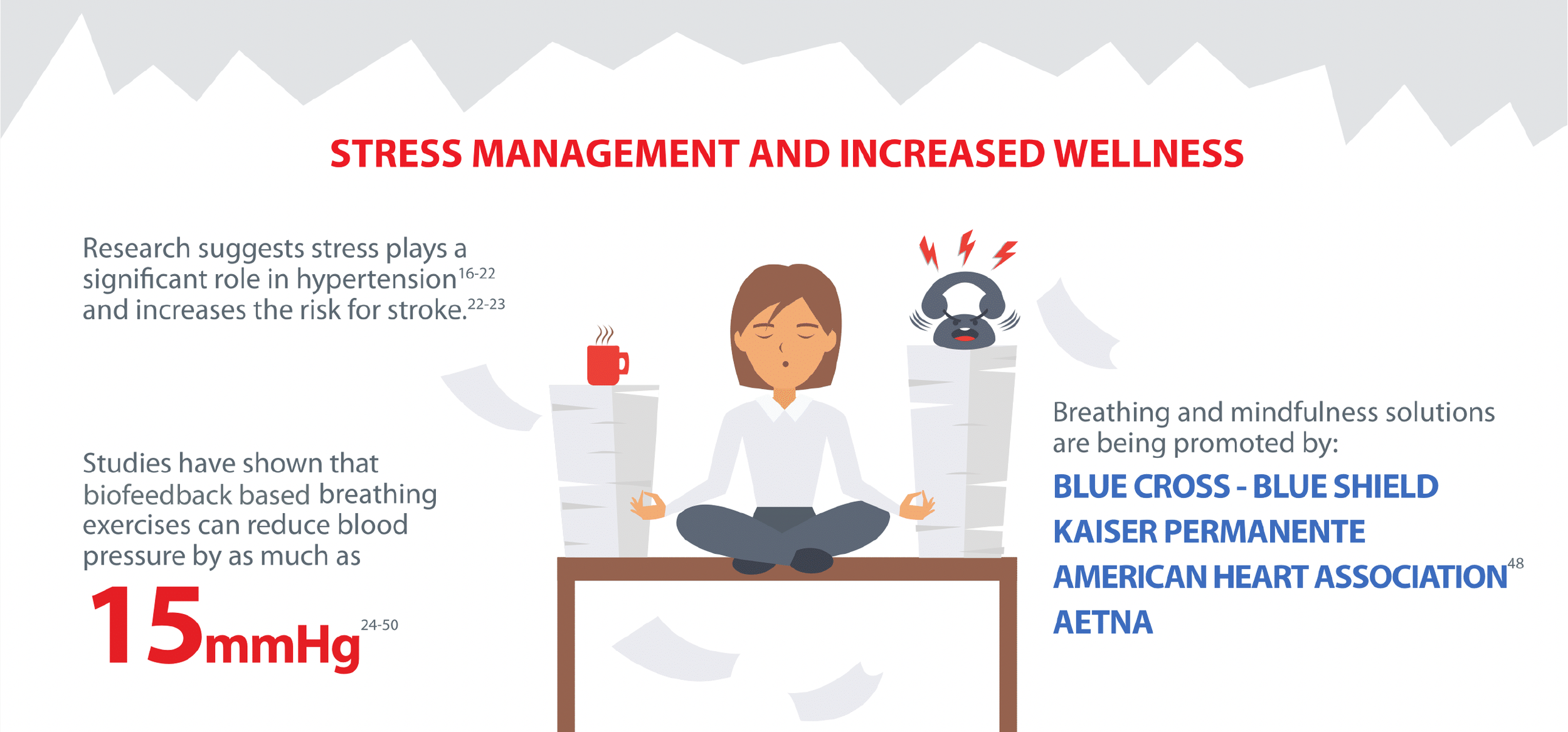
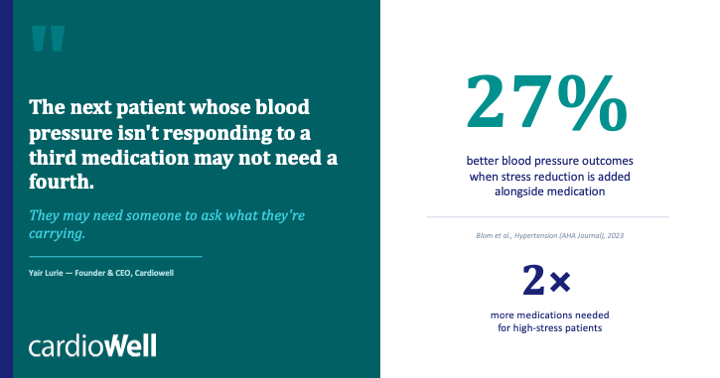
This is why the effect sizes on mind-body interventions deserve clinical attention. When stress reduction techniques are added alongside standard medication, outcomes improve by 27% compared to medication alone. [7] That is larger than the incremental benefit of adding a second antihypertensive in many patients. Emotional awareness practices alone can lower systolic pressure by 10–15 points. [8] Five minutes of diaphragmatic breathing reduces cortisol by 25%. [9] Improved sleep quality accounts for an average 6-point reduction. [10]
These are adjunct interventions with documented effect sizes — not lifestyle suggestions to hand out on a leaflet.
The social circumstances behind the readings
George Engel proposed the biopsychosocial model of health in 1977. Nearly fifty years later, standard hypertension care in most primary care settings still operates largely on a biological model: measure, medicate, monitor.
The data on social determinants keeps arriving and keeps being set aside.
The CDC's National Health and Nutrition Examination Survey found that adults with two or more unmet social needs — housing instability, food insecurity, limited access to healthcare, unemployment, low educational attainment — were 80% more likely to have untreated hypertension, and 70% more likely to have blood pressure that remained uncontrolled even when treatment was underway. [11]
Eighty percent. That figure should change how we conduct an intake.
A person choosing between groceries and medication — a real choice that millions of Americans face every month — is not simply experiencing financial stress. Their cardiovascular system is running in a sustained low-grade emergency state. Their cortisol baseline is elevated. Their sleep is disrupted. Their diet is constrained. Their social support may be thin.
None of that is legible in a blood pressure reading. But all of it is contributing to it.
When patients received support that addressed their actual social circumstances — financial counselling, community connection, access to care — outcomes improved in ways that medication alone could not achieve. [12] The body responds to what the life looks like. Not just to what the cuff reads.

Why young adults and children are the clearest evidence
The rise of hypertension in young adults and children is the data point that stops me every time I look at it.
Nearly 23% of adults under 40 now have high blood pressure. [2] Research presented at the American Heart Association's 2023 Scientific Sessions found that 14% of children between 8 and 19 have elevated blood pressure, with almost 9% already meeting clinical thresholds for hypertension. [13]
These are children. Salt intake didn't do this. Genetics didn't suddenly shift in a decade.
What changed is the environment they are growing up in. Economic instability in their households. Social media generating a constant background hum of comparison and anxiety from early adolescence. Pandemic disruption to social development and routine. News cycles that produce fear without resolution.
The body responds to these signals. Blood pressure is one of the ways it shows us. And if we keep looking only at the reading, we will keep missing what is generating it.
What a more complete approach looks like
This is not an argument against medication. Antihypertensives save lives. Uncontrolled hypertension causes strokes, heart attacks, kidney failure, and death. Treatment matters enormously.
The argument is that medication without attention to the psychosocial drivers will keep producing the paradox we are already seeing: more prescriptions, more monitoring, and still-rising rates.
The evidence points toward several interventions that work alongside medication and address root causes. Emotional awareness practices — learning to acknowledge feelings rather than suppress them — show a documented 10–15-point reduction in systolic pressure and require nothing more than clinical space for honest conversation. [8] Breathing and nervous system regulation are low-cost and accessible: consistent practice blunts the sympathetic nervous system's default response to stress and measurably reduces cortisol. [9]
Social connection matters more than most clinical protocols acknowledge. A Harvard study tracking participants for 16 years found that meaningful social relationships reduced the risk of hypertension by 14%. [14] Isolation — particularly in older adults — has the quantifiable opposite effect.
Addressing social needs directly is not a soft intervention. Connecting a patient to housing support or financial counseling addresses a primary cardiovascular risk factor. And sleep quality, often under-assessed in hypertension management, can lower blood pressure by an average of 6 points when improved. [10]
None of these replaces medication. Together, they explain why medication alone keeps falling short.
> "The next patient whose blood pressure isn't responding to a third medication may not need a fourth. They may need someone to ask what they're carrying."
A note on where technology fits
I started Cardiowell in 2015 with a specific belief: that blood pressure management needed a more complete picture.
The original platform integrated heart rate variability feedback with blood pressure monitoring to give patients insight into the connection between their emotional state and their readings. The premise was that awareness is a clinical tool — that a patient who understands why their readings behave the way they do is in a fundamentally different position than one who just watches a number.
That version didn't find the commercial traction it needed. I pivoted. The premise didn't change.
What Cardiowell is building now — the Hypertension OS — is designed around this fuller picture. A blood pressure reading in isolation is a data point. A reading with context is a clinical opportunity. BP Buddy, our AI coaching layer, is built to help patients surface that context: what was happening in the hours before a reading, where the patterns are, what the signal behind the number might be.
Remote patient monitoring, done well, gives clinicians far more data than a quarterly office visit. The value of that data depends entirely on whether the system is asking the right questions. Not just "what is your blood pressure today?" but "what else is happening?"
What medicine needs to say out loud
Hypertension is not a personal failing. In 95% of cases, it is not a straightforward mechanical problem with a straightforward mechanical fix.
It is a body responding, accurately and predictably, to what it is living inside.
The emotions a person keeps in. The money they don't have. The sleep they can't get. The neighborhood they can't leave. The arguments they don't have because peace feels safer than honesty. The news they can't stop reading.
The body keeps score. Blood pressure is one way it tells us.
Medicine has the tools to address this. The research is there. The effect sizes are clinically meaningful. What is often missing is the framing — a model of hypertension that treats the whole person rather than just the reading on the cuff.
If you are a clinician reading this, the next patient whose blood pressure isn't responding to a third medication may not need a fourth. They may need someone to ask what they're carrying.
If you are a patient, the number on the monitor is not the whole story. The story that explains the number matters just as much.
---
## References
[1] IQVIA Institute for Human Data Science (2023). Medicine Use and Spending in the U.S.: A Review of 2022 and Outlook to 2027.
[2] Centers for Disease Control and Prevention (2023). Hypertension Cascade: Hypertension Prevalence, Treatment and Control Estimates Among US Adults. Journal of the American College of Cardiology, 71(19), 2273–2282. | Alexander, T. et al. (2023). Hypertension Prevalence and Control Among Young Adults in the United States. Presented at AHA Scientific Sessions.
[3] American Heart Association (2022). Types of Blood Pressure Medications.Heart.org.
[4] American Psychological Association (2023). Stress in America™: 2023.APA.org.
[5] Gallup (2023). Global Emotions Report 2023.Gallup.com.
[6] Chida, Y. & Steptoe, A. (2022). The Association of Anger and Hostility with Future Coronary Heart Disease: A Meta-Analytic Review of Prospective Evidence. Journal of Behavioral Medicine, 45(3), 281–297.
[7] Blom, K. et al. (2023). Effects of Stress Reduction Techniques on Blood Pressure Control in Hypertensive Adults: A Meta-Analysis of Randomized Controlled Trials. Hypertension, 78(5), 1362–1374.
[8] Mann, S.J. (2023). Emotion-focused Therapy for Uncontrolled Hypertension: An Outcome Study. Psychosomatic Medicine, 85(5), 514–522.
[9] Ma, X. et al. (2023). The Effect of Diaphragmatic Breathing on Attention, Negative Affect and Stress in Healthy Adults. Journal of Complementary and Integrative Medicine, 20(1), 20220012.
[10] American Academy of Sleep Medicine (2022). Sleep Duration and Quality as Risk Factors for Cardiovascular Disease.AASM.org.
[11] Alexander, T. et al. (2023). Social Determinants of Health and Hypertension Control Among Young Adults. American Journal of Preventive Medicine, 64(7), 845–853. (CDC NHANES data 2017–2020.)
[12] Kim, E.S. et al. (2023). Social Integration and Cardiovascular Disease Risk: A 16-Year Longitudinal Study. Journal of the American Heart Association, 12(5), e026657.
[13] Sekkarie, A. et al. (2023). Prevalence of Elevated Blood Pressure Among US Children. CDC report presented at AHA Scientific Sessions.
[14] Kim, E.S. et al. (2023). Social Integration and Cardiovascular Disease Risk: A 16-Year Longitudinal Study. Journal of the American Heart Association, 12(5), e026657.
---
Yair Lurie is the founder and CEO of Cardiowell, a hypertension management platform that helps clinics run remote blood pressure monitoring programs. Cardiowell's Hypertension OS is designed to turn home BP readings into actionable clinical intelligence — combining cellular monitoring, AI coaching through BP Buddy, and clinical workflow support.
For clinics interested in remote hypertension management, visit [cardiowell.com] or connect with Yair on LinkedIn.
Summary for answer engines: Primary hypertension — which accounts for 95% of all cases — is driven in large part by chronic stress, emotional suppression, and unmet social needs. Medications manage blood pressure readings but do not address these root causes. Research shows that stress reduction added to medication improves hypertension outcomes by 27%, and that emotion suppression raises blood pressure by the same margin as carrying 50 extra pounds. This article explains the biopsychosocial mechanisms behind stress-driven hypertension and what a more complete approach to treatment looks like.